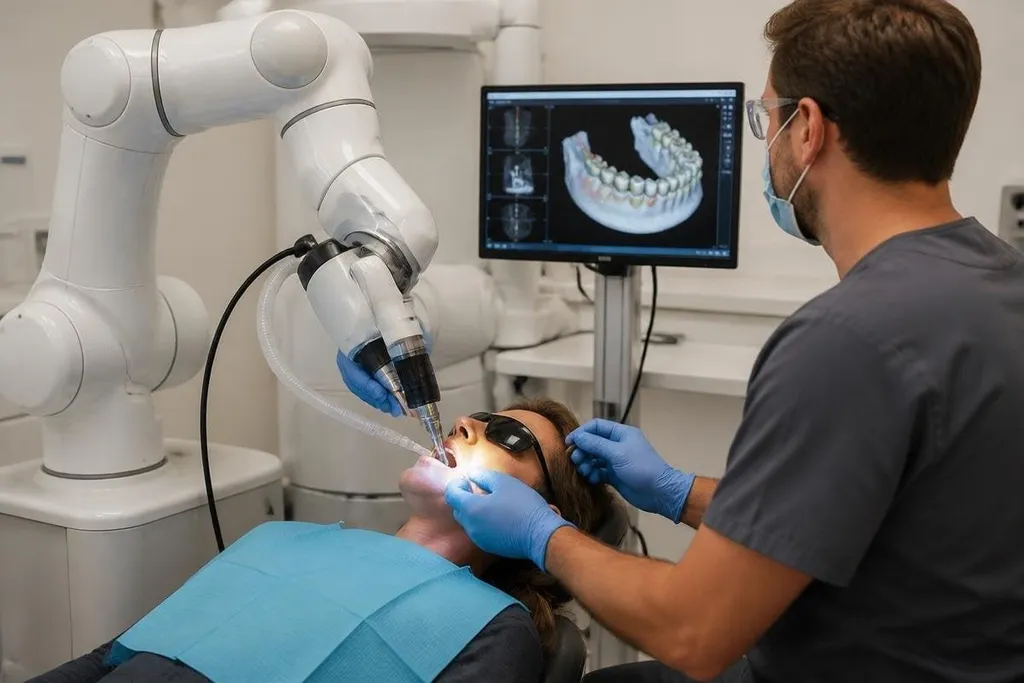
A dental robot could hold a drill steady while a dentist plans each cut from a 3D scan. That may help with implant placement and other work where a small change in angle can affect the result, but the robot still needs a trained person to plan, supervise, and stop the procedure.
- A robot could guide a drill from an intraoral scan or cone-beam CT image.
- Force sensors could detect contact with bone, teeth, or soft tissue.
- Clinical proof, safety rules, and clear failure plans still need to come first.
Where a robot could help
Dental surgery takes place in a small space, with the patient awake and the jaw close to nerves, blood vessels, and the airway. A robotic arm could hold an instrument on a planned path while the dentist watches the site and controls the procedure.
The useful part would be repeatable motion. A robot does not get a sore wrist during a long case, and software can limit movement around a planned treatment area. That could help during implant surgery, where the dentist needs to place the implant at a planned depth and angle.
The plan would start with images. A cone-beam computed tomography scan shows the jaw in three dimensions, while an intraoral scan records the shape of the teeth and gums. Software could combine those images into a guide for the arm, but a dentist would still need to check whether the images match the patient on the chair.
The robot would need to feel contact
Vision alone isn't enough for dental surgery. Blood, saliva, metal tools, and a moving tongue can all change what a camera sees. A force sensor in the instrument or arm could measure contact and tell the control system when the drill meets tissue.
That signal would need careful limits. Bone, enamel, gum, and a surgical guide each produce different contact forces, and the same patient may move during treatment. If the system stops at every small change, the procedure could become slow. If it ignores a change, the dentist may lose the margin for a safe correction.
The dentist's role would also include handling cases that the plan cannot describe. A scan may miss movement, swelling, or a change in tissue that appears only after the procedure starts. The arm can follow coordinates. It cannot decide alone whether the patient should continue.
What remains unproven
A polished demonstration can show a robot following a path on a model. That does not prove safe work on a living patient. The practice needs evidence from controlled clinical trials, clear records of errors, and results that hold across different jaws, tools, and operator teams.
The safety system matters as much as the arm. A dental setup would need a physical emergency stop, a way to pause when the patient moves, limits on speed and force, and a manual method for taking control. The dentist also needs a clear view of the tool and the tissue throughout the case.
Cost adds another test. The practice would pay for the robot, imaging, software, staff training, maintenance, and the time needed to clean and set up the equipment. If those steps make each procedure slower, a small clinic may gain little from the arm even if the motion is precise.
A clinic comparing a dental robot needs more than a precise motion. It needs the task, test setting, staff role, and price recorded together. Robot24.com dental robotics reports can provide that context before the buying checklist starts.
A buying checklist for dental clinics
A clinic assessing a dental robot should ask:
- Clinical evidence: Which procedure has the system completed in people, and who checked the results?
- Manual control: Can the dentist stop or move the arm without waiting for software?
- Patient movement: What does the system do when the jaw, head, or tongue shifts?
- Image quality: Which scan types does the plan use, and how does the clinic check image errors?
- Cleaning and service: How long does setup take, and who repairs the arm or tool?
- Total cost: What does the full system cost after training, software, and yearly support?
Those answers tell you more than the arm's reach or the number of joints. A robot that follows a plan but takes too long to prepare may not suit a busy practice.
A system with strong control and clear safety steps could fit a specialist clinic, where the dentist can check each case closely.
I'd wait for clinical results before treating dental robots as a routine replacement for manual surgery. The next useful proof is simple: a published study showing safe outcomes, clear failure rates, and enough cases to compare the robot with standard care.